Vine Drawing: Step-by-Step Tutorial & Easy Ideas
If you can draw a simple center with petal or leaf shapes around it, you can draw a vine. That's genuinely the whole secret — the rest is knowing which lines to add in which order, and this tutorial shows you exactly that, step by step, before serving up a full list of vine drawing ideas to practice with.
- Difficulty Easy
- Time ~12 min
- Tools Pencil, eraser, paper
- Starts with a simple center with petal or leaf shapes around it
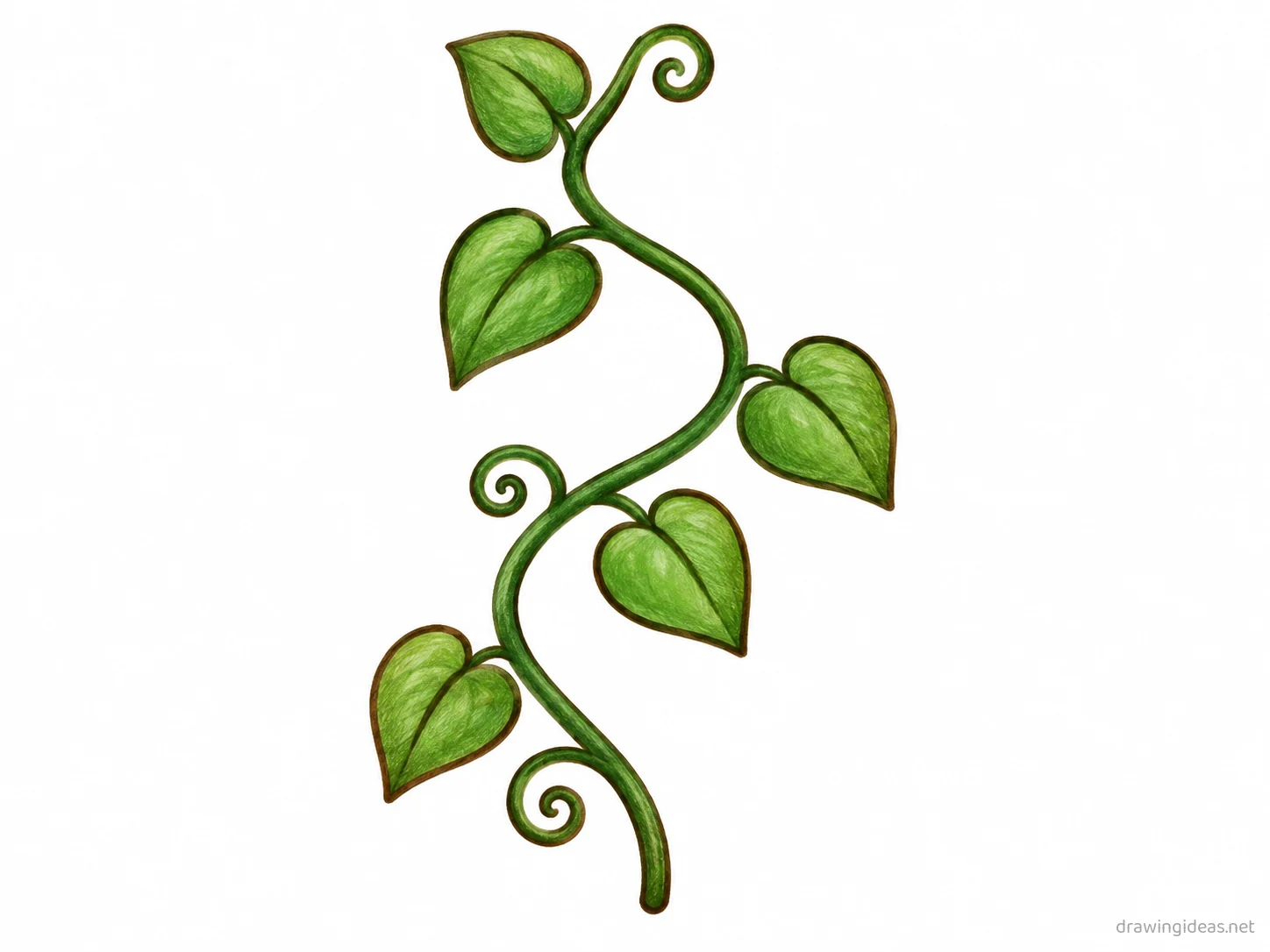
How to Draw a Vine Step by Step
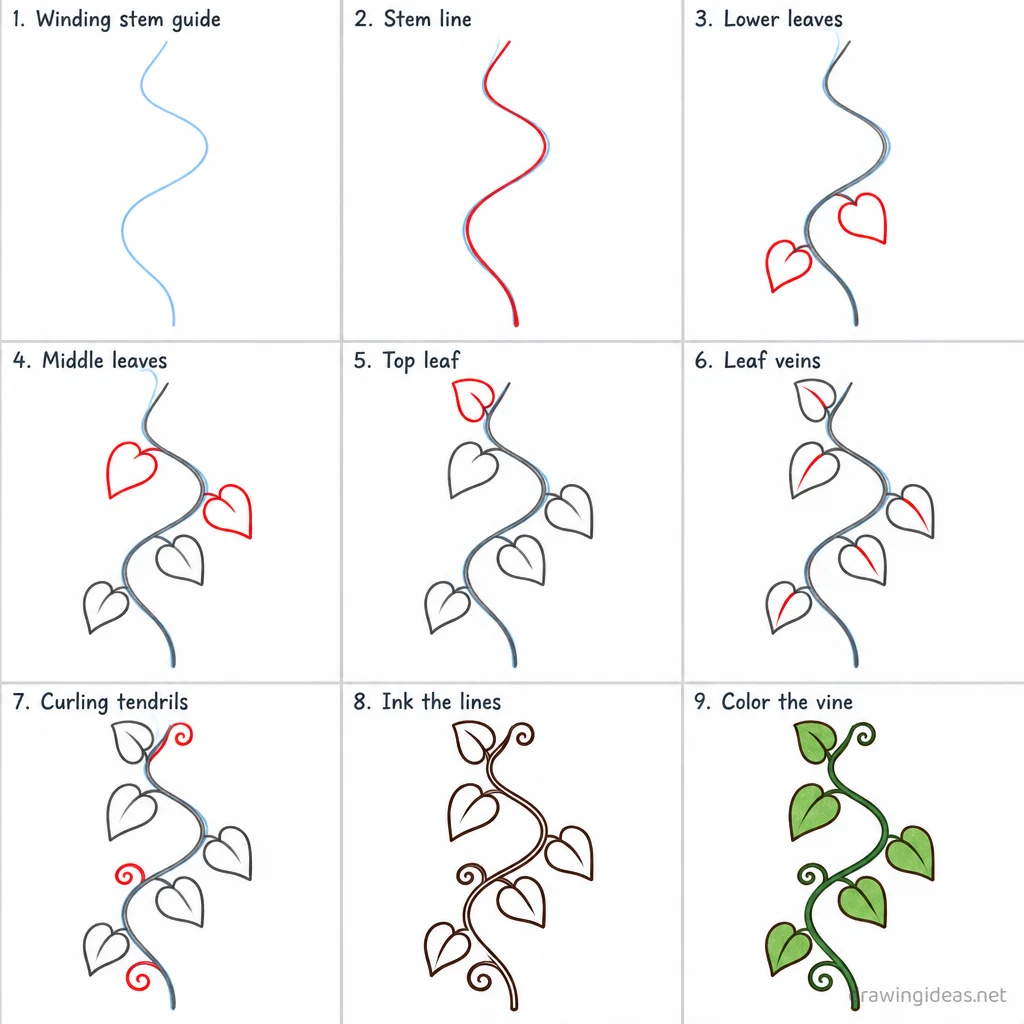
Step 1 of 9
Winding stem guide
Draw one light winding S-curve line from the bottom of the page up to the top to plan the vine's path.
-
Winding stem guide
Draw one light winding S-curve line from the bottom of the page up to the top to plan the vine's path.
-
Stem line
Trace a bold winding stem over the guide curve, slightly thicker near the bottom than at the top.
-
Lower leaves
Add two heart-shaped leaves along the lower part of the stem, pointing away from the curve on alternating sides.
-
Middle leaves
Add two more heart-shaped leaves along the middle of the stem, pointing outward on alternating sides.
-
Top leaf
Add one more heart-shaped leaf near the top of the stem, pointing upward and outward.
-
Leaf veins
Add one curved vein down the center of each of the five leaves, from its base to its tip.
-
Curling tendrils
Add three small spiral tendrils curling out from the stem at three different points along its length.
-
Ink the lines
Go over every kept line with dark ink, then erase the light winding guide curve.
-
Color the vine
Fill the stem and tendrils dark green and the leaves a lighter fresh green.
Vine Drawing Ideas to Try Next
Once the basic vine clicks, run it through these variations — each one practices a different skill while staying on a subject you already know.
-
A vine wreath
Repeat small versions in a circle guideline — the highest-value use of one flower you've learned.
-
A vine growth cycle strip
Bud, half-open, full bloom in three panels — repetition with a story built in.
-
A vine border or corner piece
Grow the vine along a page edge or corner — perfect for journals, cards, and letters.
-
Vine in a simple vase
Add a basic vessel and you've turned a flower doodle into a still life.
-
A single vine study
One bloom, centered, drawn slowly from life or photo — the classic botanical exercise that always ends frameable.
-
Pressed-flower style flat vine
Draw it perfectly flat and symmetrical like a pressed specimen, with a handwritten label beneath.
-
A bee or butterfly visiting your vine
One tiny pollinator turns a plant study into a scene.
-
Line-art vine tattoo design
Single-weight clean outline, no shading — minimalist flash style.
Tips for Better Vine Drawings
- Draw petals from the center outward, letting each one overlap a neighbor. Overlap is what separates a flower from a pinwheel.
- Nature is never symmetrical — if your flower looks stiff, rotate a few petals, vary their widths, and let one droop. Imperfect petals read as alive.
Not feeling the vine today?
Let the generator pick your next subject — filtered by mood and difficulty.
🎲 Random Drawing GeneratorVine Drawing FAQ
How do you draw a vine easily?
Start with a simple center with petal or leaf shapes around it, keeping your lines light. Refine the outline, add the defining details, then erase the construction shapes. The nine-step method above breaks this down — most people get a recognizable vine on their very first try with it.
How long does a vine drawing take?
A simple vine drawing takes about 12 minutes following this tutorial. A quick doodle version can be done in two or three minutes, while a detailed, fully-shaded study might take an hour. Speed comes with repetition — the second attempt is always faster than the first.
What do I need to draw a vine?
Just a pencil, an eraser, and any paper. An HB pencil for construction lines and a 2B for final outlines is a nice upgrade, and colored pencils or markers finish it off — but nothing on this page requires special supplies.
Is a vine easy to draw for beginners?
Yes — the vine is one of the friendlier subjects for beginners, and this method was written for first-timers. Kids can follow the same steps; just expect wobblier lines and more charm.