Pond Drawing: Step-by-Step Tutorial & Easy Ideas
Pond drawings are one of the most-loved sketching subjects, and for good reason — the basic version comes together from a horizon line and two or three big simple shapes in just a few minutes. Follow the nine steps below to get the foundations right, then browse the ideas list for your next pond sketch.
- Difficulty Medium
- Time ~15 min
- Tools Pencil, eraser, paper
- Starts with a horizon line and two or three big simple shapes
How to Draw a Pond Step by Step
Step 1 of 9
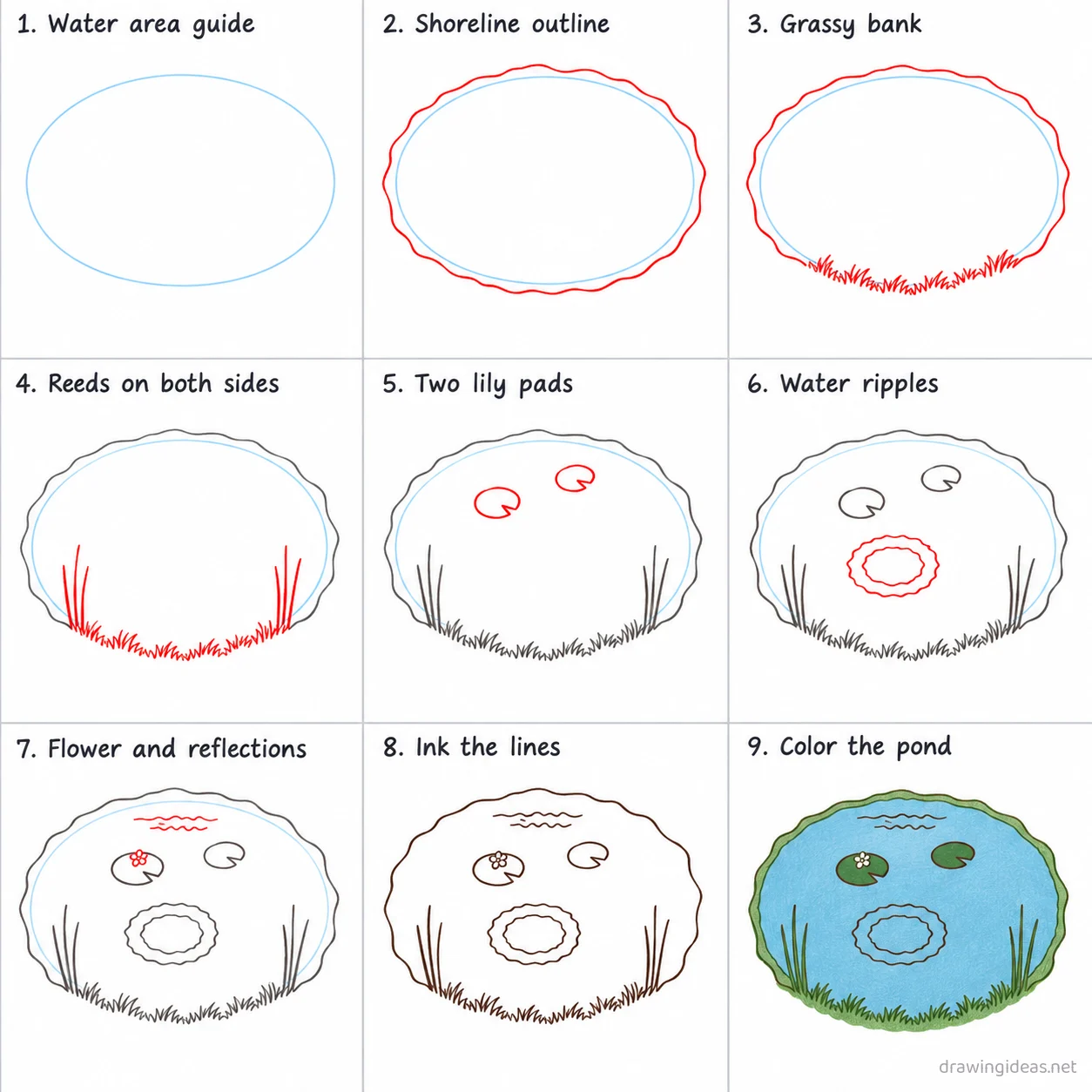
Water area guide
Draw one large light oval filling most of the middle of the page for the pond's water.
-
Water area guide
Draw one large light oval filling most of the middle of the page for the pond's water.
-
Shoreline outline
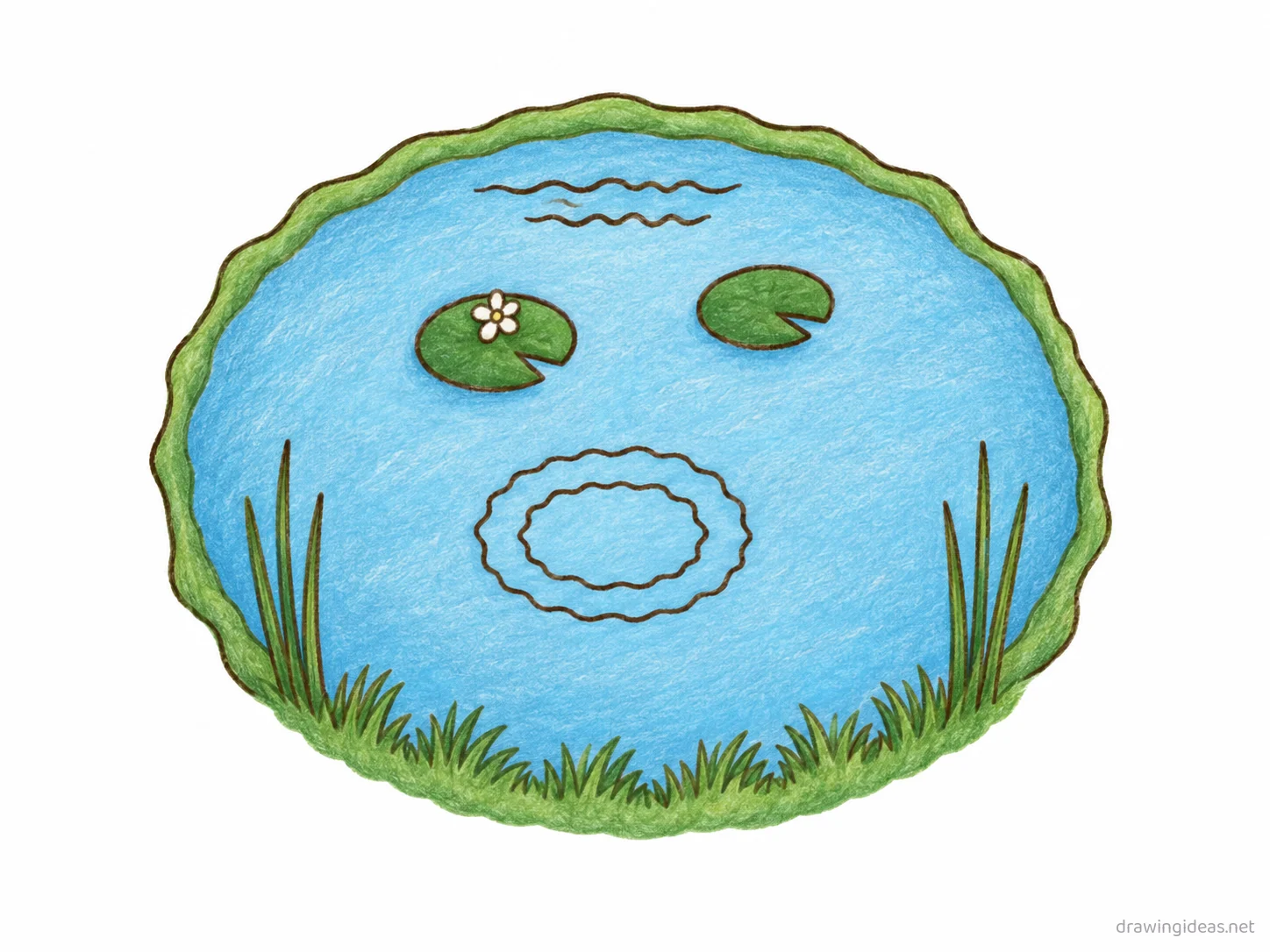
Trace a slightly bumpy wavy shoreline on the oval so the water edge looks natural instead of perfectly round.
-
Grassy bank
Add a band of short grass tufts along the bottom edge of the shoreline for the bank.
-
Reeds on both sides
Draw a few tall thin reed stalks rising from the bank on the left and on the right.
-
Two lily pads
Add two small round lily pads floating in the upper part of the water, each with a small notch cut in.
-
Water ripples
Draw two wavy ripple rings in the open water below the lily pads.
-
Flower and reflections
Add a tiny flower on one lily pad, then a few short wavy reflection lines near the top of the water.
-
Ink the lines
Go over every kept line with dark ink, then erase the light water oval guide.
-
Color the pond
Fill the water blue, the bank and reeds green, the lily pads darker green, and the flower white.
Pond Drawing Ideas to Try Next
Once the basic pond clicks, run it through these variations — each one practices a different skill while staying on a subject you already know.
-
Pond at golden hour
Same drawing, warm palette, long shadows — light does the heavy lifting.
-
Pond through a window frame
Draw a simple window and place the pond outside it — built-in composition and cozy mood.
-
A minimalist one-line pond scene
Reduce the pond to its simplest continuous line — modern, framable, and fast.
-
A tiny pond in a glass jar
The miniature-world trend: your pond scene bottled with a cork on top.
-
Day and night split pond
Divide the page down the middle and render the same pond in both lightings.
-
A postcard-style pond
Frame it in a rectangle with a hand-lettered greeting — vintage travel poster energy.
-
Pond with a wanderer figure
One tiny silhouette person gazing at your big pond — instant scale and story.
Tips for Better Pond Drawings
- Detail only the focal area and let the edges stay loose. The viewer’s eye goes where the detail is; detail everywhere means focus nowhere.
- Squint at your reference until it blurs into 3–4 big shapes — draw those shapes first. Every landscape that "looks off" skipped this step.
Not feeling the pond today?
Let the generator pick your next subject — filtered by mood and difficulty.
🎲 Random Drawing GeneratorPond Drawing FAQ
How do you draw a pond easily?
Start with a horizon line and two or three big simple shapes, keeping your lines light. Refine the outline, add the defining details, then erase the construction shapes. The nine-step method above breaks this down — most people get a recognizable pond on their very first try with it.
How long should it take to draw a pond?
A simple pond drawing takes about 15 minutes following this tutorial. A quick doodle version can be done in two or three minutes, while a detailed, fully-shaded study might take an hour. Speed comes with repetition — the second attempt is always faster than the first.
What do I need to draw a pond?
Just a pencil, an eraser, and any paper. An HB pencil for construction lines and a 2B for final outlines is a nice upgrade, and colored pencils or markers finish it off — but nothing on this page requires special supplies.
Is a pond easy to draw for beginners?
Yes — the pond is very manageable once you use construction shapes, and this method was written for first-timers. Kids can follow the same steps; just expect wobblier lines and more charm.