Cityscape Drawing: Step-by-Step Tutorial & Easy Ideas
Cityscape drawings are one of the most-loved sketching subjects, and for good reason — the basic version comes together from stacked rectangles with a roof shape in just a few minutes. Follow the nine steps below to get the foundations right, then browse the ideas list for your next cityscape sketch.
- Difficulty Medium
- Time ~18 min
- Tools Pencil, eraser, paper
- Starts with stacked rectangles with a roof shape

How to Draw a Cityscape Step by Step
Step 1 of 9
Tall building and ground
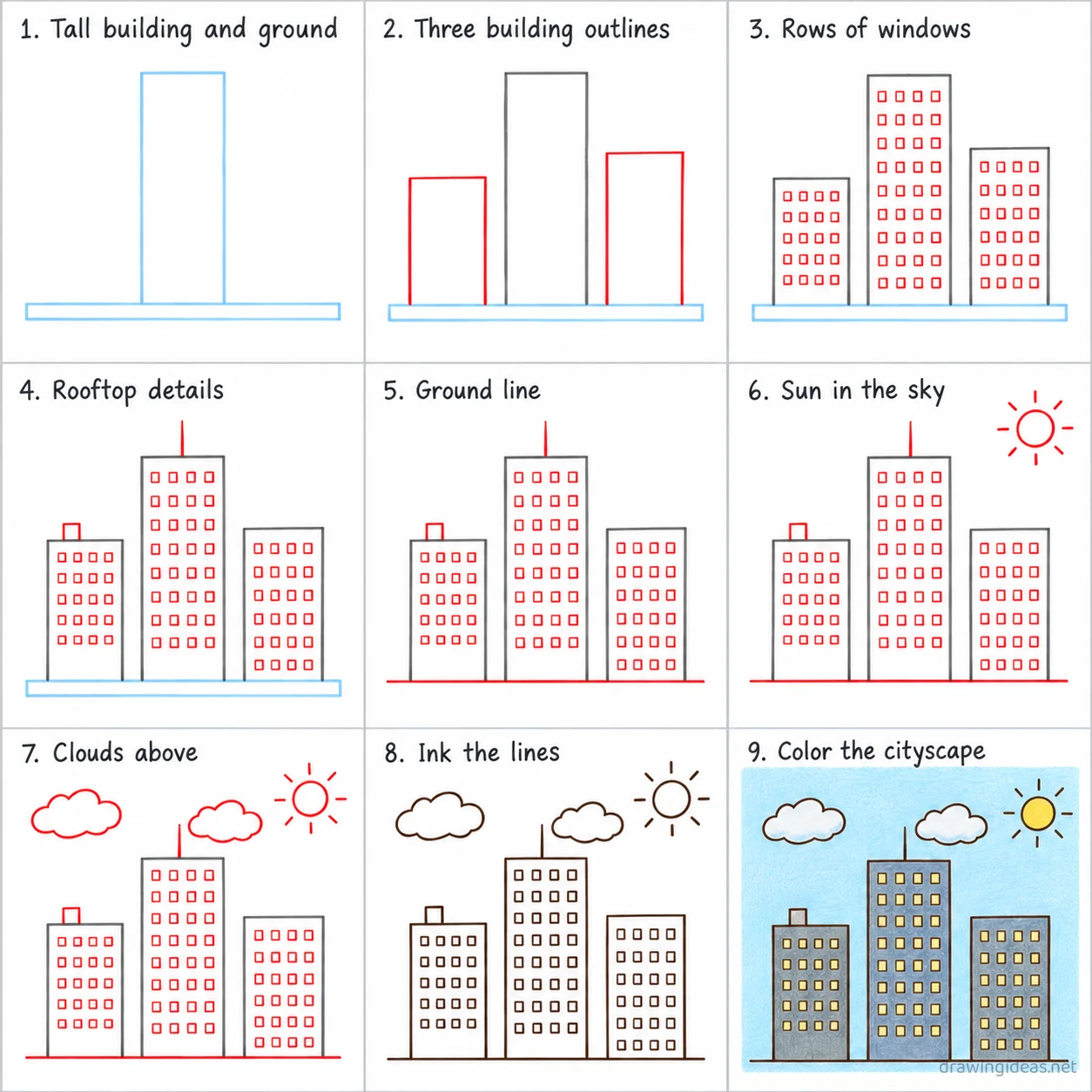
Draw a tall light rectangle in the middle of the page for the tallest building, and a thin guide strip across the bottom for the ground.
-
Tall building and ground
Draw a tall light rectangle in the middle of the page for the tallest building, and a thin guide strip across the bottom for the ground.
-
Three building outlines
Trace the tall middle building, then add a shorter building on the left and a medium building on the right, all sharing the same base line.
-
Rows of windows
Fill each building with small evenly spaced square windows arranged in neat rows and columns.
-
Rooftop details
Add a thin antenna rising from the tall building's roof and a small square unit on the left building's roof.
-
Ground line
Draw one straight line across the very bottom of the page connecting the base of all three buildings.
-
Sun in the sky
In the upper right corner draw a simple round sun with a few short rays around it.
-
Clouds above
Add two soft bumpy clouds near the top of the page, floating above the rooftops.
-
Ink the lines
Go over every kept line with dark ink, then erase the light tall-building and ground guides.
-
Color the cityscape
Fill the buildings in shades of gray and blue, the windows pale yellow, the sun bright yellow, and the sky light blue.
Cityscape Drawing Ideas to Try Next
Once the basic cityscape clicks, run it through these variations — each one practices a different skill while staying on a subject you already know.
-
Cityscape at night with lit windows
Dark silhouette, warm yellow windows — two tones that do all the storytelling.
-
Isometric mini cityscape
Draw it at the video-game 30° angle, clean lines, flat colors — the most satisfying architectural style to learn.
-
Cityscape reflected in water
The structure above a wavy mirrored copy below — draw the reflection with broken horizontal lines.
-
A cityscape floating on an island
Draw it on a chunk of floating earth with roots dangling below — the classic fantasy vignette.
-
A crooked storybook cityscape
Let every line lean and bulge on purpose — fairy-tale architecture is anatomy-proof.
Tips for Better Cityscape Drawings
- Add one scale reference (a figure, a door, a tree) — buildings only feel big next to something small.
- Windows and doors align in rows and columns — builders use levels. Misaligned openings are the #1 tell of a rushed building drawing.
Not feeling the cityscape today?
Let the generator pick your next subject — filtered by mood and difficulty.
🎲 Random Drawing GeneratorCityscape Drawing FAQ
How do you draw a cityscape easily?
Start with stacked rectangles with a roof shape, keeping your lines light. Refine the outline, add the defining details, then erase the construction shapes. The nine-step method above breaks this down — most people get a recognizable cityscape on their very first try with it.
How long should it take to draw a cityscape?
A simple cityscape drawing takes about 18 minutes following this tutorial. A quick doodle version can be done in two or three minutes, while a detailed, fully-shaded study might take an hour. Speed comes with repetition — the second attempt is always faster than the first.
What do I need to draw a cityscape?
Just a pencil, an eraser, and any paper. An HB pencil for construction lines and a 2B for final outlines is a nice upgrade, and colored pencils or markers finish it off — but nothing on this page requires special supplies.
Is a cityscape easy to draw for beginners?
Yes — the cityscape is very manageable once you use construction shapes, and this method was written for first-timers. Kids can follow the same steps; just expect wobblier lines and more charm.