Eiffel Tower Drawing: Step-by-Step Tutorial & Easy Ideas
Every good Eiffel Tower drawing starts the same way: stacked rectangles with a roof shape, refined step by step into a finished piece. Below you'll find a complete step-by-step tutorial you can follow with any pencil and paper, plus easy Eiffel Tower drawing ideas — from quick five-minute doodles to more detailed studies.
- Difficulty Medium
- Time ~18 min
- Tools Pencil, eraser, paper
- Starts with stacked rectangles with a roof shape
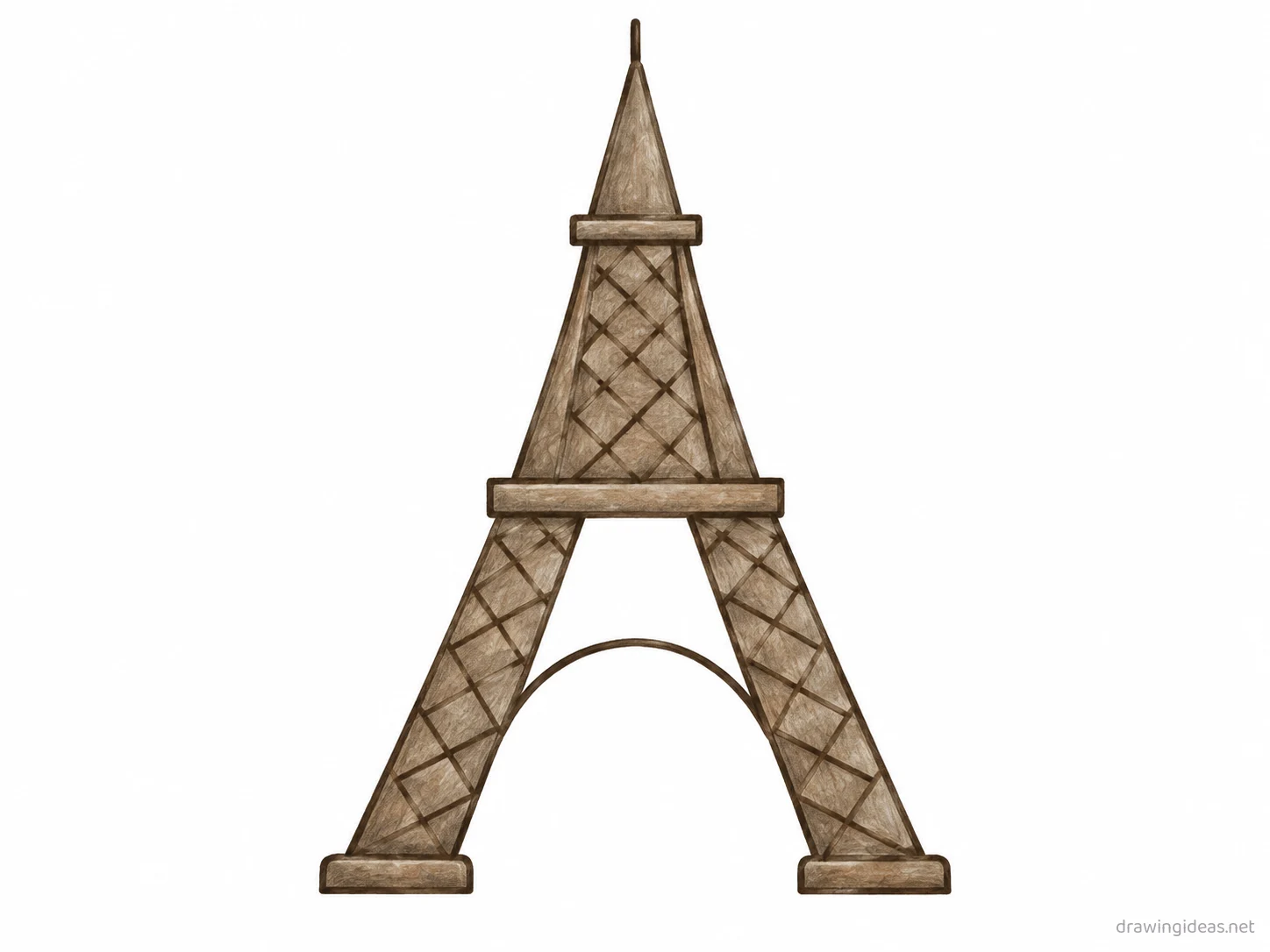
How to Draw the Eiffel Tower Step by Step
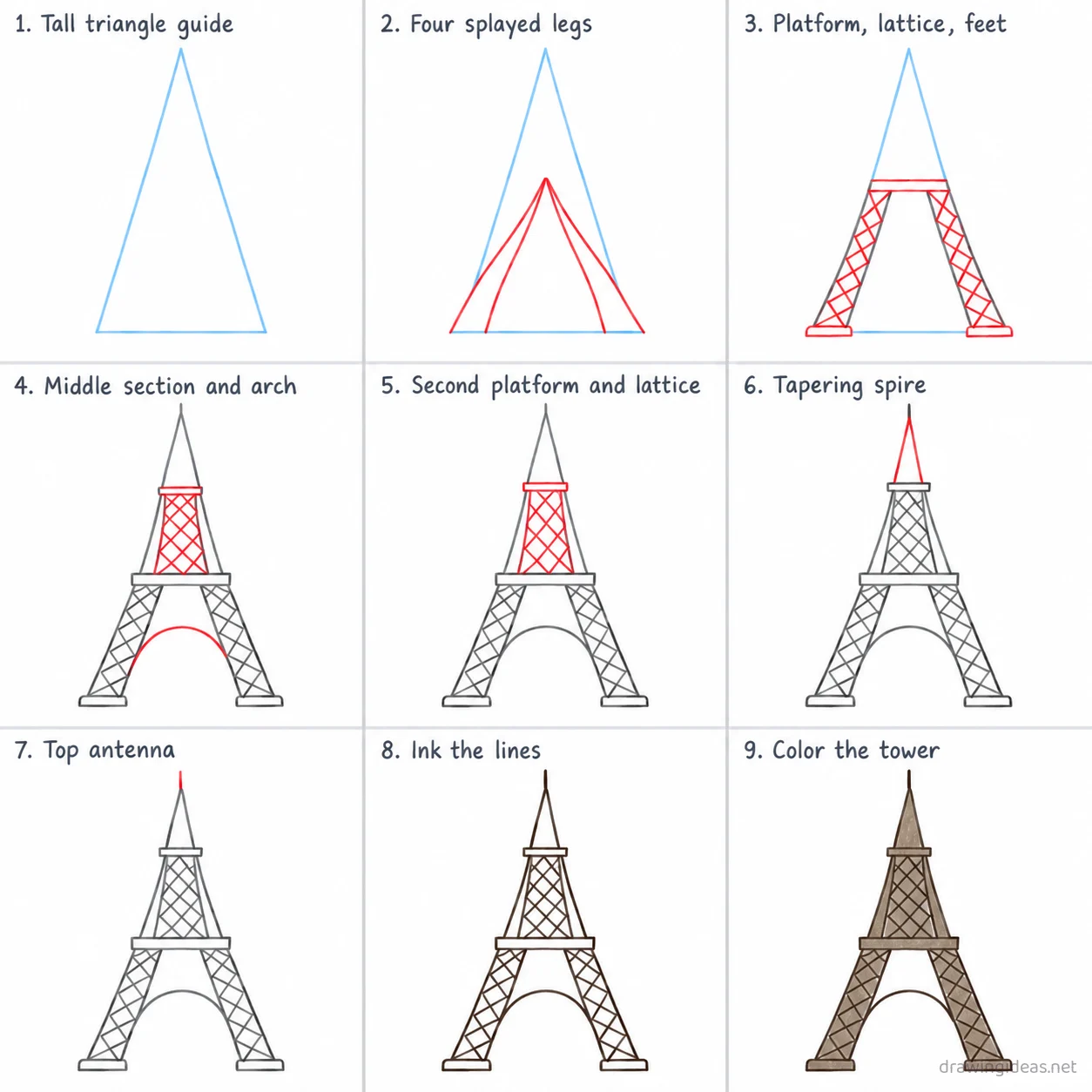
Step 1 of 9
Tall triangle guide
Draw a light tall triangle filling most of the page, point at the top and a wide flat base near the bottom.
-
Tall triangle guide
Draw a light tall triangle filling most of the page, point at the top and a wide flat base near the bottom.
-
Four splayed legs
Trace four curving legs along the triangle's sides, wide at the base and curving inward as they rise.
-
Platform, lattice, feet
Draw the horizontal platform where the legs meet, fill the legs with a crisscross lattice pattern, and add a foot pad under each leg.
-
Middle section and arch
Draw a tapering tower rising from the first platform, then a large curved arch connecting the legs above the base.
-
Second platform and lattice
Draw a horizontal platform at the top of the middle section, then fill that section with a crisscross lattice pattern.
-
Tapering spire
Draw a thin tapering spire rising from the second platform up to a point.
-
Top antenna
Draw a thin antenna line rising above the spire's point.
-
Ink the lines
Go over every kept line with dark ink, then erase the light triangle guide.
-
Color the tower
Fill the entire iron structure a warm brownish gray.
Eiffel Tower Drawing Ideas to Try Next
Once the basic Eiffel Tower clicks, run it through these variations — each one practices a different skill while staying on a subject you already know.
-
Eiffel Tower reflected in water
The structure above a wavy mirrored copy below — draw the reflection with broken horizontal lines.
-
An Eiffel Tower floating on an island
Draw it on a chunk of floating earth with roots dangling below — the classic fantasy vignette.
-
Eiffel Tower at night with lit windows
Dark silhouette, warm yellow windows — two tones that do all the storytelling.
-
Isometric mini Eiffel Tower
Draw it at the video-game 30° angle, clean lines, flat colors — the most satisfying architectural style to learn.
-
A crooked storybook Eiffel Tower
Let every line lean and bulge on purpose — fairy-tale architecture is anatomy-proof.
Eiffel Tower Drawing Styles: Easy, Cute & More
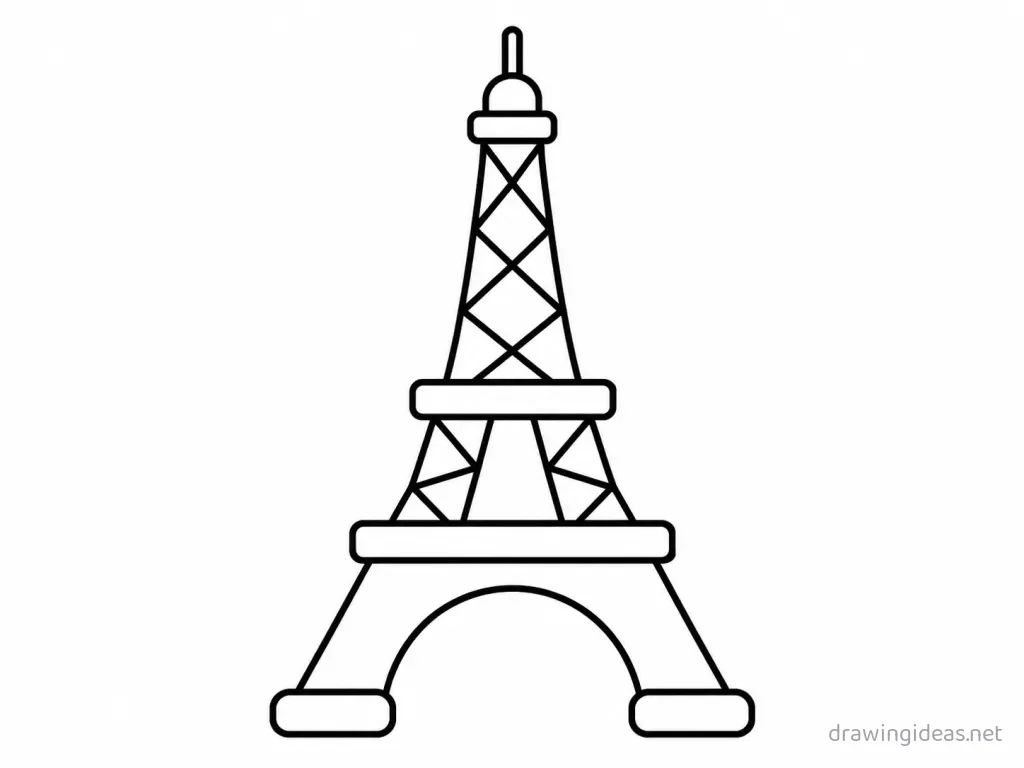
Easy Eiffel Tower Drawing
Try a simplified version built from basic shapes — perfect for beginners and kids. Same nine steps as above — simply simplify or stylize the final pass.
Tips for Better Eiffel Tower Drawings
- Windows and doors align in rows and columns — builders use levels. Misaligned openings are the #1 tell of a rushed building drawing.
- Add one scale reference (a figure, a door, a tree) — buildings only feel big next to something small.
Not feeling the Eiffel Tower today?
Let the generator pick your next subject — filtered by mood and difficulty.
🎲 Random Drawing GeneratorEiffel Tower Drawing FAQ
How do you draw the Eiffel Tower easily?
Start with stacked rectangles with a roof shape, keeping your lines light. Refine the outline, add the defining details, then erase the construction shapes. The nine-step method above breaks this down — most people get a recognizable Eiffel Tower on their very first try with it.
How long should it take to draw the Eiffel Tower?
A simple Eiffel Tower drawing takes about 18 minutes following this tutorial. A quick doodle version can be done in two or three minutes, while a detailed, fully-shaded study might take an hour. Speed comes with repetition — the second attempt is always faster than the first.
What supplies do I need for Eiffel Tower drawings?
Just a pencil, an eraser, and any paper. An HB pencil for construction lines and a 2B for final outlines is a nice upgrade, and colored pencils or markers finish it off — but nothing on this page requires special supplies.
Is the Eiffel Tower easy to draw for beginners?
Yes — the Eiffel Tower is very manageable once you use construction shapes, and this method was written for first-timers. Kids can follow the same steps; just expect wobblier lines and more charm.