Wing Drawing: Step-by-Step Tutorial & Easy Ideas
Wing drawings are one of the most-loved sketching subjects, and for good reason — the basic version comes together from a dramatic silhouette built on real anatomy in just a few minutes. Follow the nine steps below to get the foundations right, then browse the ideas list for your next wing sketch.
- Difficulty Medium
- Time ~25 min
- Tools Pencil, eraser, paper
- Starts with a dramatic silhouette built on real anatomy
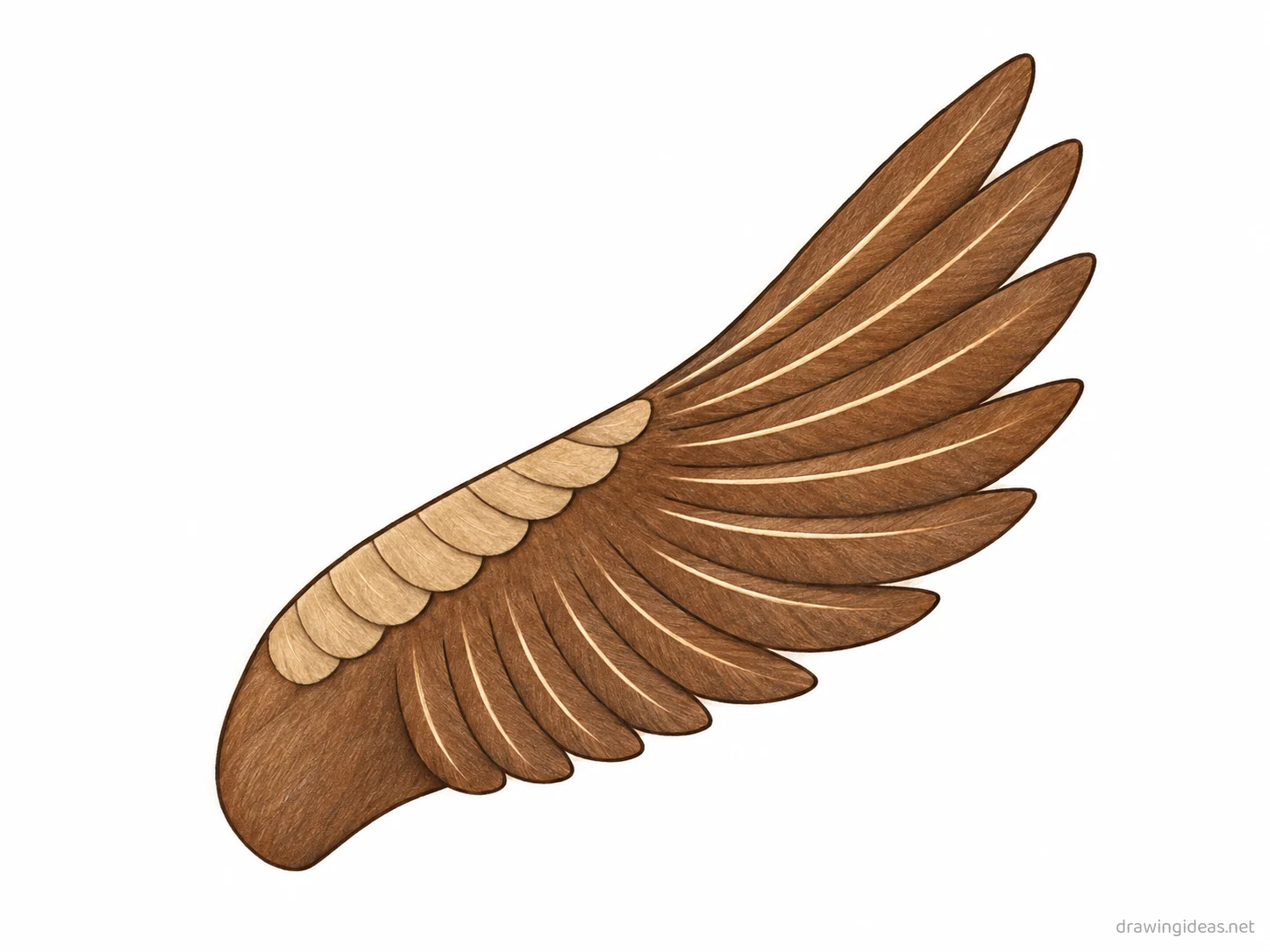
How to Draw a Wing Step by Step
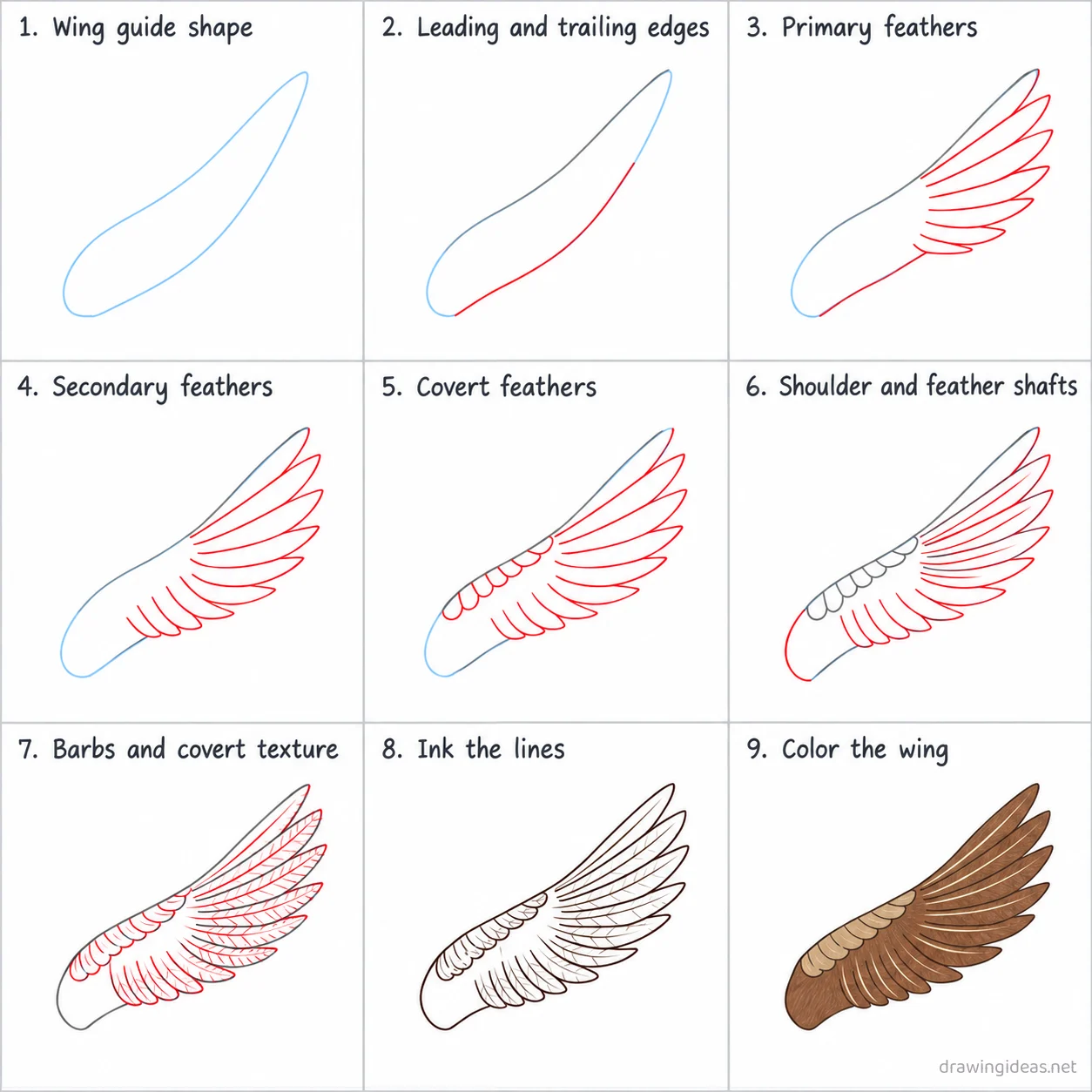
Step 1 of 9
Wing guide shape
Draw a light curved shape sweeping from the lower left up to the upper right, wide near the base and narrow at the tip.
-
Wing guide shape
Draw a light curved shape sweeping from the lower left up to the upper right, wide near the base and narrow at the tip.
-
Leading and trailing edges
Trace the top curve of the guide as the leading edge, then draw a second curve below it for the trailing edge.
-
Primary feathers
From the outer trailing edge, fan out five long pointed feathers reaching toward the wing tip.
-
Secondary feathers
Along the inner trailing edge, add four shorter feathers pointing outward and slightly downward.
-
Covert feathers
Along the leading edge near the shoulder, draw six small overlapping oval feathers like shingles.
-
Shoulder and feather shafts
Round off the base of the wing with a smooth curve, then draw a thin center line down each primary and secondary feather.
-
Barbs and covert texture
Add short diagonal barb lines along each primary shaft, then short curved lines inside each covert feather.
-
Ink the lines
Go over every kept line with dark ink, then erase the light wing guide shape.
-
Color the wing
Fill the primary and secondary feathers warm brown, the coverts a lighter tan, and the shafts cream.
Wing Drawing Ideas to Try Next
Once the basic wing clicks, run it through these variations — each one practices a different skill while staying on a subject you already know.
-
A wing guarding treasure
Add a small pile of coins and one glowing gem — the scene writes itself.
-
A tiny wing familiar on a shoulder
Pocket-sized companion version perched on a simple shoulder line.
-
A baby wing
Shrink it, enlarge the eyes and head, add one stubby feature — cuteness transforms any fearsome subject.
-
Skeletal or spectral wing
Draw the ghost/bone version with wispy trailing edges — halloween-ready and forgiving of anatomy.
-
Wing tattoo flash design
Bold outline, limited shading, designed to fit a shoulder — flash style suits fantasy subjects perfectly.
Tips for Better Wing Drawings
- Design the silhouette first: fantasy subjects live or die on outline. Fill your sketch with black and check that it still reads.
- Ground the fantasy in real anatomy — borrow joints, weight, and balance from real animals, then exaggerate. Believability comes from the real bones underneath.
Not feeling the wing today?
Let the generator pick your next subject — filtered by mood and difficulty.
🎲 Random Drawing GeneratorWing Drawing FAQ
What is the easiest way to draw a wing?
Start with a dramatic silhouette built on real anatomy, keeping your lines light. Refine the outline, add the defining details, then erase the construction shapes. The nine-step method above breaks this down — most people get a recognizable wing on their very first try with it.
How long should it take to draw a wing?
A simple wing drawing takes about 25 minutes following this tutorial. A quick doodle version can be done in two or three minutes, while a detailed, fully-shaded study might take an hour. Speed comes with repetition — the second attempt is always faster than the first.
What do I need to draw a wing?
Just a pencil, an eraser, and any paper. An HB pencil for construction lines and a 2B for final outlines is a nice upgrade, and colored pencils or markers finish it off — but nothing on this page requires special supplies.
Can kids draw a wing?
Yes — the wing is very manageable once you use construction shapes, and this method was written for first-timers. Kids can follow the same steps; just expect wobblier lines and more charm.