Isaac Newton Drawing: Step-by-Step Tutorial & Easy Ideas
Isaac Newton drawings are one of the most-loved sketching subjects, and for good reason — the basic version comes together from one clear outline divided into labeled regions in just a few minutes. Follow the nine steps below to get the foundations right, then browse the ideas list for your next Isaac Newton sketch.
- Difficulty Medium
- Time ~15 min
- Tools Pencil, eraser, paper
- Starts with one clear outline divided into labeled regions
How to Draw Isaac Newton Step by Step
Step 1 of 9
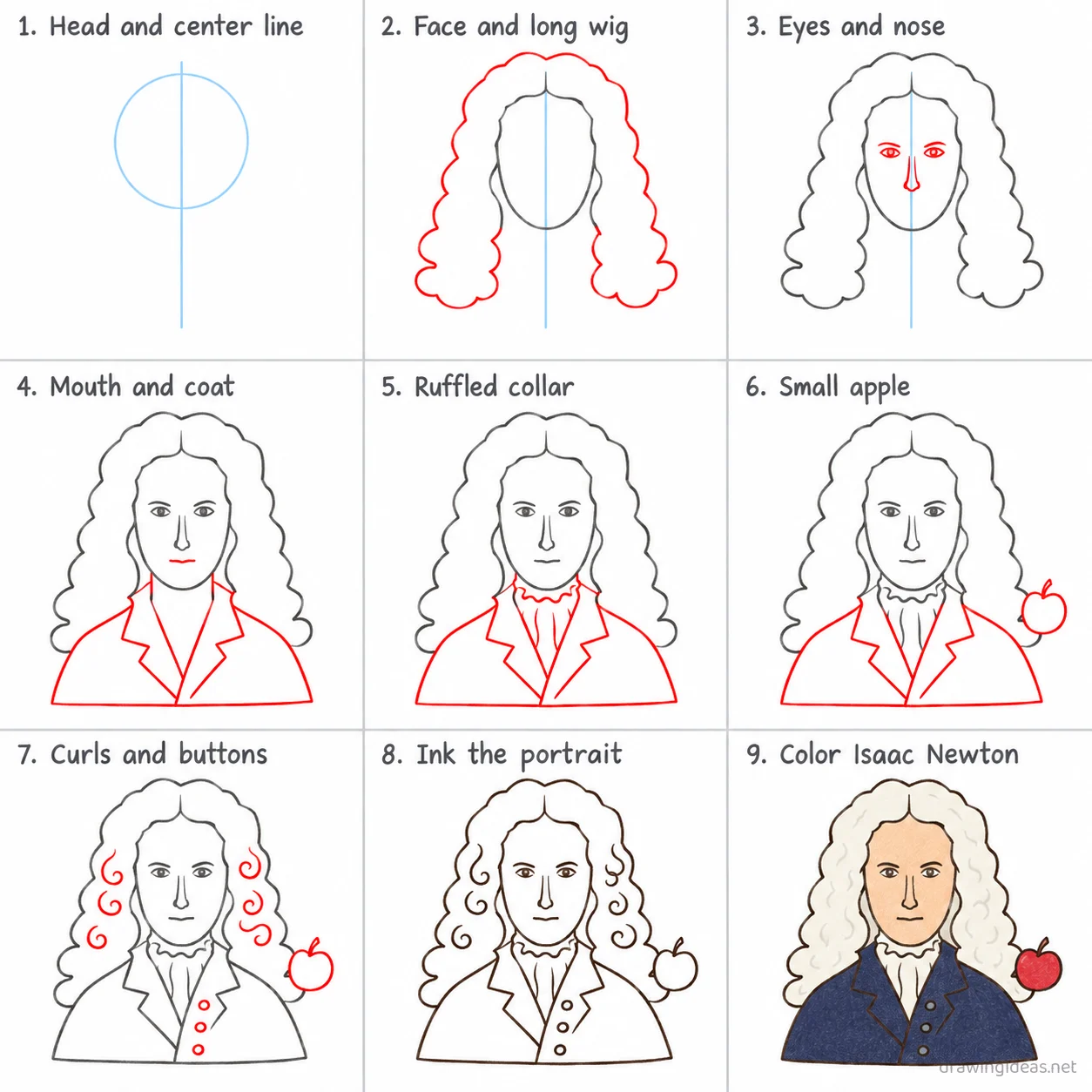
Head and center line
Draw a light circle for the head in the upper middle of the page, then a straight vertical line down the middle for symmetry.
-
Head and center line
Draw a light circle for the head in the upper middle of the page, then a straight vertical line down the middle for symmetry.
-
Face and long wig
Trace the lower head circle into a narrow face with a rounded chin, then add a long curled wig framing the face down to the shoulders.
-
Eyes and nose
Add two small level eyes centered on the middle line, then a straight nose line below them.
-
Mouth and coat
Draw a short closed mouth just above the chin, then a rounded coat and shoulder outline below the face with a lapel opening at the chest.
-
Ruffled collar
Add a soft ruffled collar peeking out above the coat's lapel opening.
-
Small apple
Draw one small round apple with a short stem resting beside the right shoulder.
-
Curls and buttons
Add a few spiral curl lines within the wig on both sides, then three small round buttons down the coat's edge.
-
Ink the portrait
Go over every kept line with dark ink, then erase the light head circle and the vertical center line.
-
Color Isaac Newton
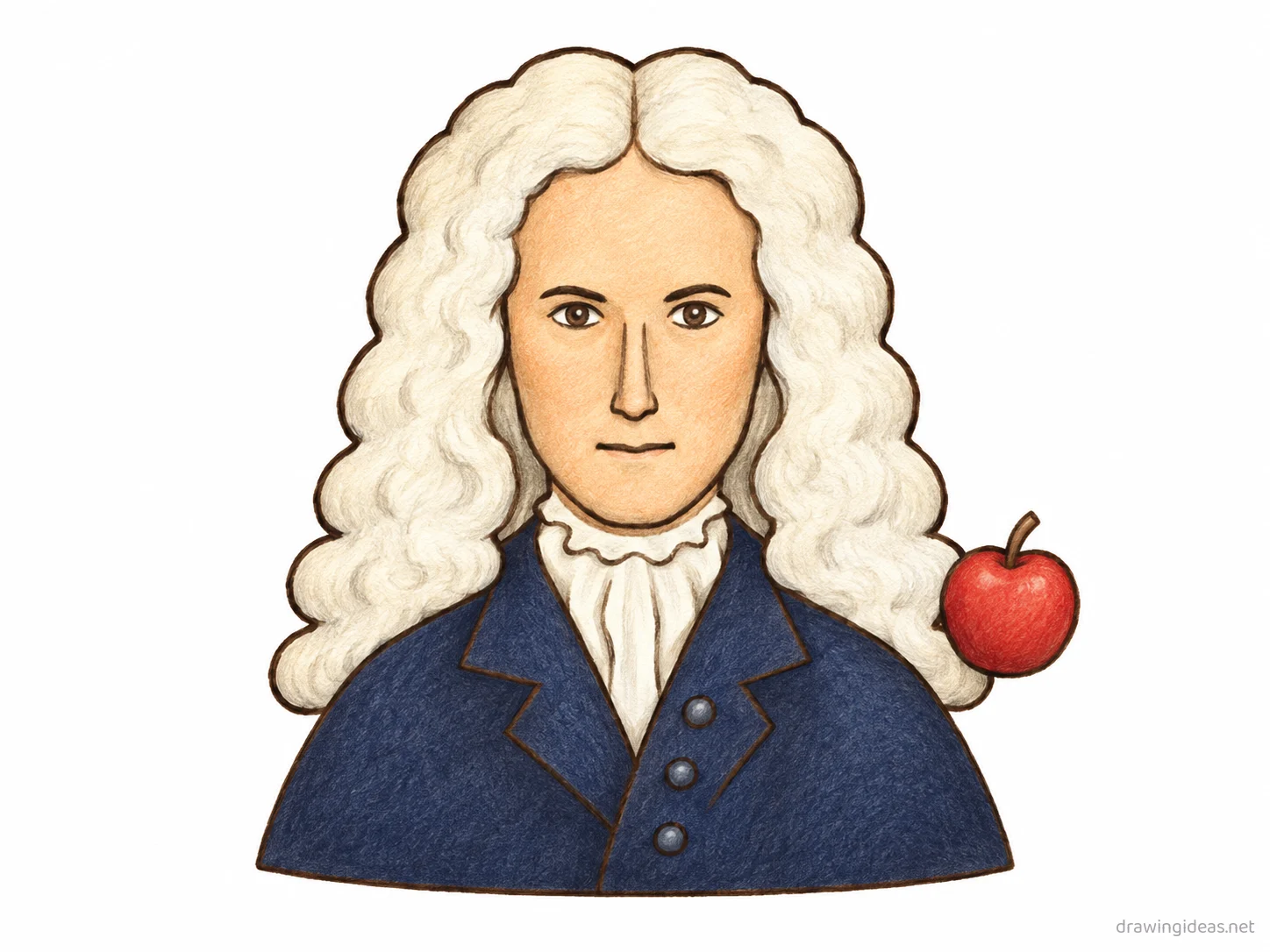
Fill the skin light tan, the wig and collar off-white, the coat deep navy, and the apple bright red.
Isaac Newton Drawing Ideas to Try Next
Once the basic Isaac Newton clicks, run it through these variations — each one practices a different skill while staying on a subject you already know.
-
A poster-style Isaac Newton with title lettering
Big title, Isaac Newton center-stage, two or three fact callouts — the class-project format.
-
A step-by-step process strip
Show Isaac Newton in stages across three or four panels, with arrows — perfect for processes and cycles.
-
Isaac Newton as a friendly cartoon
Give it eyes and a smile — the memorable-mnemonic style that makes studying stick.
-
A labeled diagram of Isaac Newton
The classic homework version: clean outline, distinct regions, straight pointer lines to printed labels.
Tips for Better Isaac Newton Drawings
- Accuracy first: check a textbook diagram before you stylize. A beautiful but wrong diagram loses marks and teaches nothing.
- Label lines should never cross each other — plan label positions around the drawing before writing any text.
Not feeling Isaac Newton today?
Let the generator pick your next subject — filtered by mood and difficulty.
🎲 Random Drawing GeneratorIsaac Newton Drawing FAQ
What is the easiest way to draw Isaac Newton?
Start with one clear outline divided into labeled regions, keeping your lines light. Refine the outline, add the defining details, then erase the construction shapes. The nine-step method above breaks this down — most people get a recognizable Isaac Newton on their very first try with it.
How long does Isaac Newton drawing take?
A simple Isaac Newton drawing takes about 15 minutes following this tutorial. A quick doodle version can be done in two or three minutes, while a detailed, fully-shaded study might take an hour. Speed comes with repetition — the second attempt is always faster than the first.
What do I need to draw Isaac Newton?
Just a pencil, an eraser, and any paper. An HB pencil for construction lines and a 2B for final outlines is a nice upgrade, and colored pencils or markers finish it off — but nothing on this page requires special supplies.
Is Isaac Newton easy to draw for beginners?
Yes — Isaac Newton is very manageable once you use construction shapes, and this method was written for first-timers. Kids can follow the same steps; just expect wobblier lines and more charm.