Flute Drawing: Step-by-Step Tutorial & Easy Ideas
If you can draw a few basic boxes and cylinders, you can draw a flute. That's genuinely the whole secret — the rest is knowing which lines to add in which order, and this tutorial shows you exactly that, step by step, before serving up a full list of flute drawing ideas to practice with.
- Difficulty Easy
- Time ~12 min
- Tools Pencil, eraser, paper
- Starts with a few basic boxes and cylinders
How to Draw a Flute Step by Step
Step 1 of 9
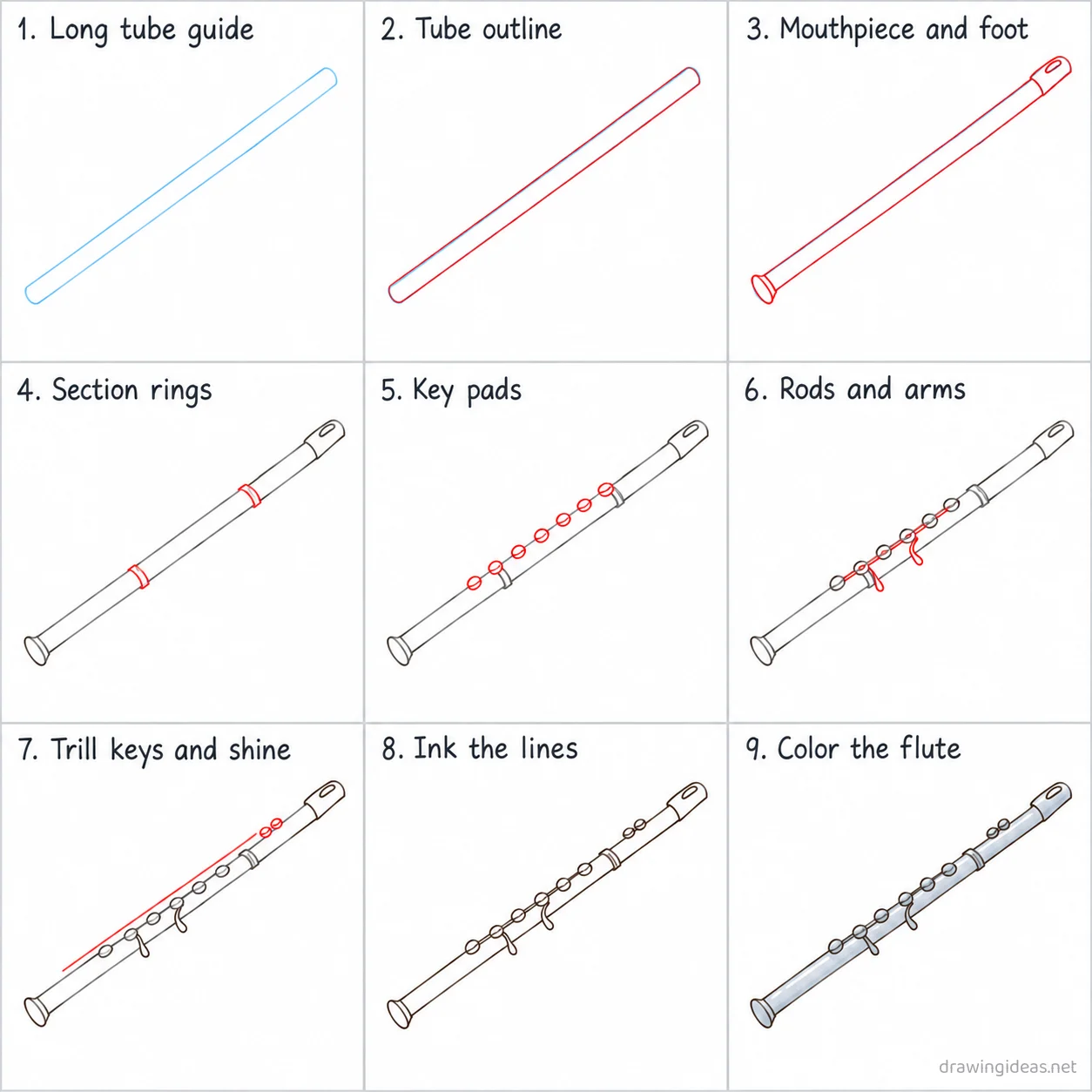
Long tube guide
Draw one light long tube shape running diagonally from the lower left corner up to the upper right corner.
-
Long tube guide
Draw one light long tube shape running diagonally from the lower left corner up to the upper right corner.
-
Tube outline
Trace the tube guide with a double line to give the flute body a clean solid outline.
-
Mouthpiece and foot
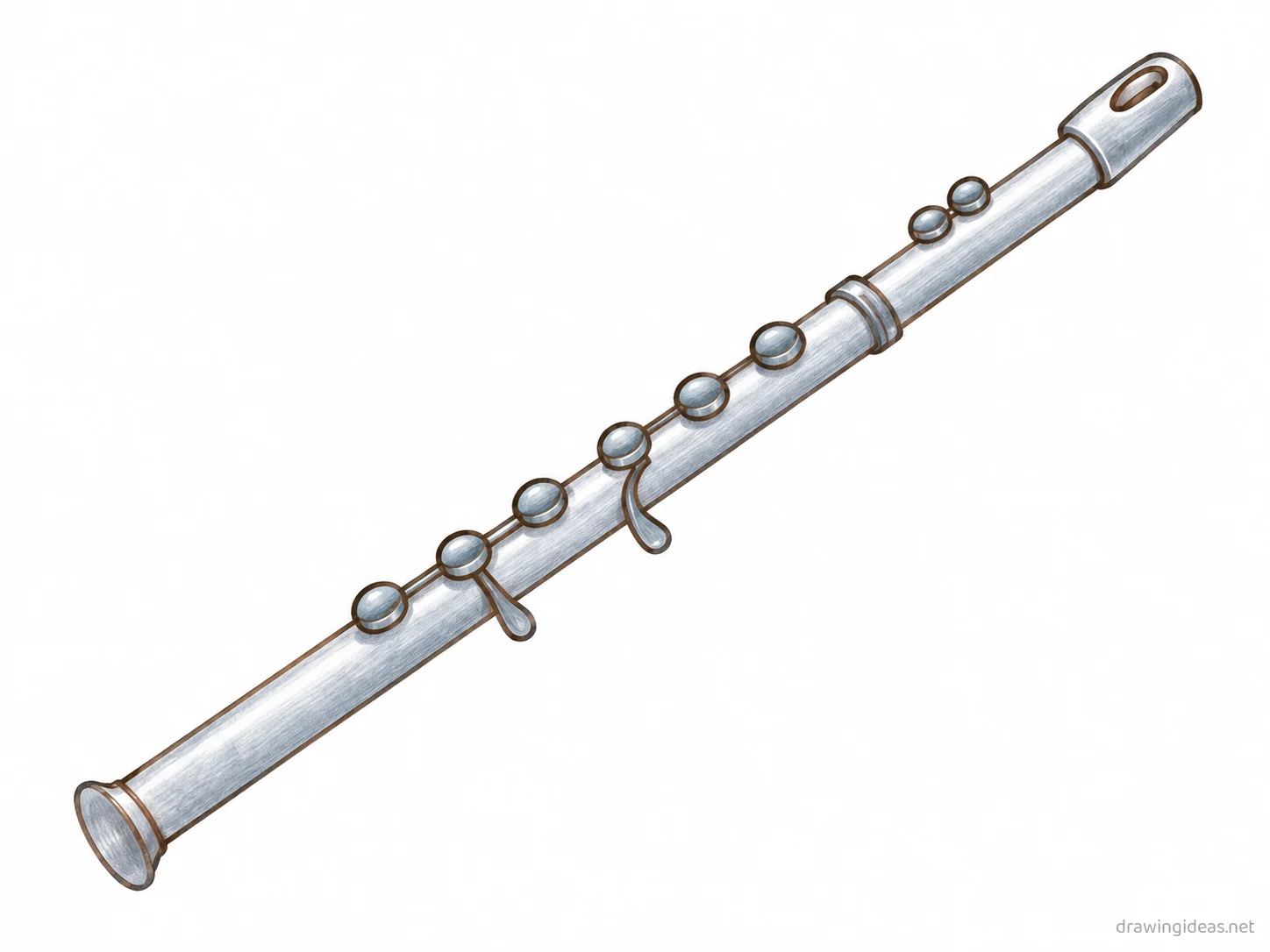
At the upper right end draw a raised mouthpiece block with a small blow hole, and a flared cap at the lower left end.
-
Section rings
Add two thin ring lines crossing the tube where the three flute sections join together.
-
Key pads
Draw a row of six round key pads evenly spaced along the top edge of the tube, from foot to mouthpiece.
-
Rods and arms
Connect the key pads with one thin rod line, then add short lever arms branching off two of the middle keys.
-
Trill keys and shine
Add two small extra keys near the mouthpiece end, then one thin highlight line along the top of the tube.
-
Ink the lines
Go over every kept line with dark ink, then erase the light tube guide underneath the finished outline.
-
Color the flute
Fill the tube body silver, the key pads a slightly darker gray, and the highlight line bright white.
Flute Drawing Ideas to Try Next
Once the basic flute clicks, run it through these variations — each one practices a different skill while staying on a subject you already know.
-
A flute as a tiny house
Add a door and windows to the flute as if someone tiny lives inside it.
-
A flute pattern sheet
Fill a page with the flute at different angles and sizes — sticker-sheet style.
-
A tiny flute on a big empty page
Miniature drawing with deliberate negative space — composition as the artwork.
-
A worn, well-loved flute
Add scratches, patches, and history — aged objects have stories new ones don't.
-
Cross-hatched vintage flute
Render it in old-encyclopedia pen style: outlines plus patient parallel hatching.
-
An exploded view of a flute
Separate the parts in mid-air like an instruction manual — deeply satisfying to draw and read.
Tips for Better Flute Drawings
- Find the object’s basic solids first (box, cylinder, sphere) and get their proportions right before any detail — detail on wrong proportions is wasted work.
- A contact shadow grounds everything: a soft dark pool where the object meets the surface is the difference between sitting and floating.
Not feeling the flute today?
Let the generator pick your next subject — filtered by mood and difficulty.
🎲 Random Drawing GeneratorFlute Drawing FAQ
What is the easiest way to draw a flute?
Start with a few basic boxes and cylinders, keeping your lines light. Refine the outline, add the defining details, then erase the construction shapes. The nine-step method above breaks this down — most people get a recognizable flute on their very first try with it.
How long does a flute drawing take?
A simple flute drawing takes about 12 minutes following this tutorial. A quick doodle version can be done in two or three minutes, while a detailed, fully-shaded study might take an hour. Speed comes with repetition — the second attempt is always faster than the first.
What supplies do I need for flute drawings?
Just a pencil, an eraser, and any paper. An HB pencil for construction lines and a 2B for final outlines is a nice upgrade, and colored pencils or markers finish it off — but nothing on this page requires special supplies.
Is a flute easy to draw for beginners?
Yes — the flute is one of the friendlier subjects for beginners, and this method was written for first-timers. Kids can follow the same steps; just expect wobblier lines and more charm.