Easy Brain Drawing: Simple Step-by-Step for Beginners
This is the simplest way to draw a brain — built from a cloud-like oval split by one curving line, with every step small enough for total beginners and kids. No shading skills, no special supplies: a pencil, an eraser and five spare minutes get you a finished, recognizable brain drawing.
- Difficulty Easy
- Time ~9 min
- Tools Pencil, eraser, paper
- Starts with a cloud-like oval split by one curving line
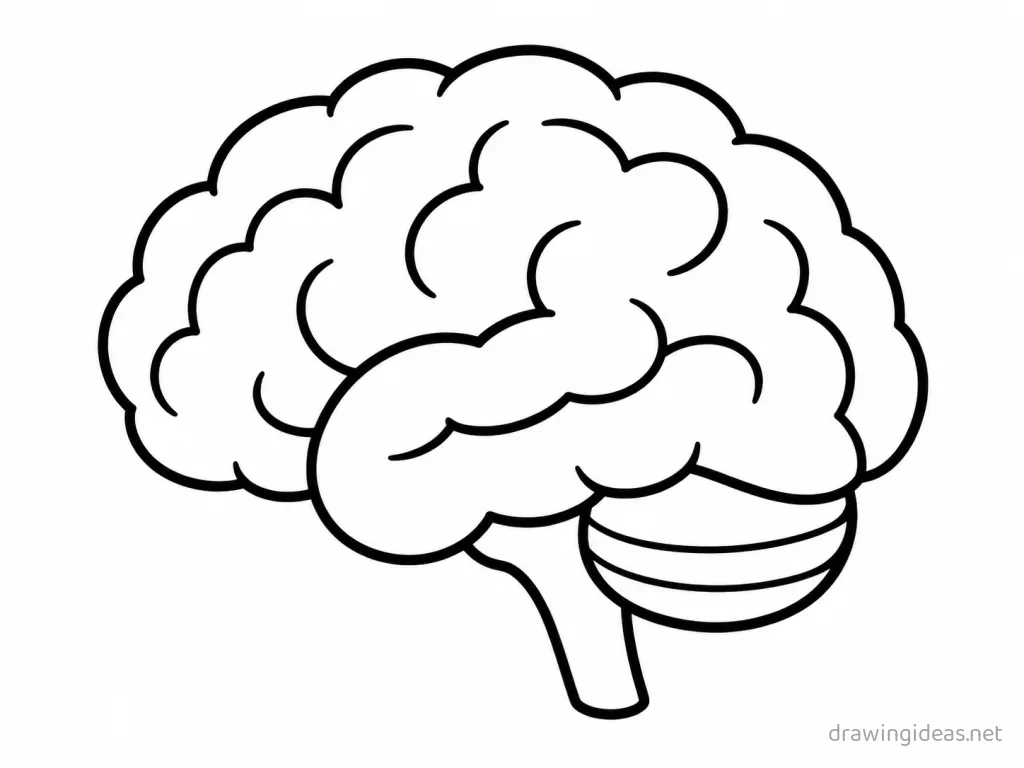
How to Draw an Easy Brain, Step by Step
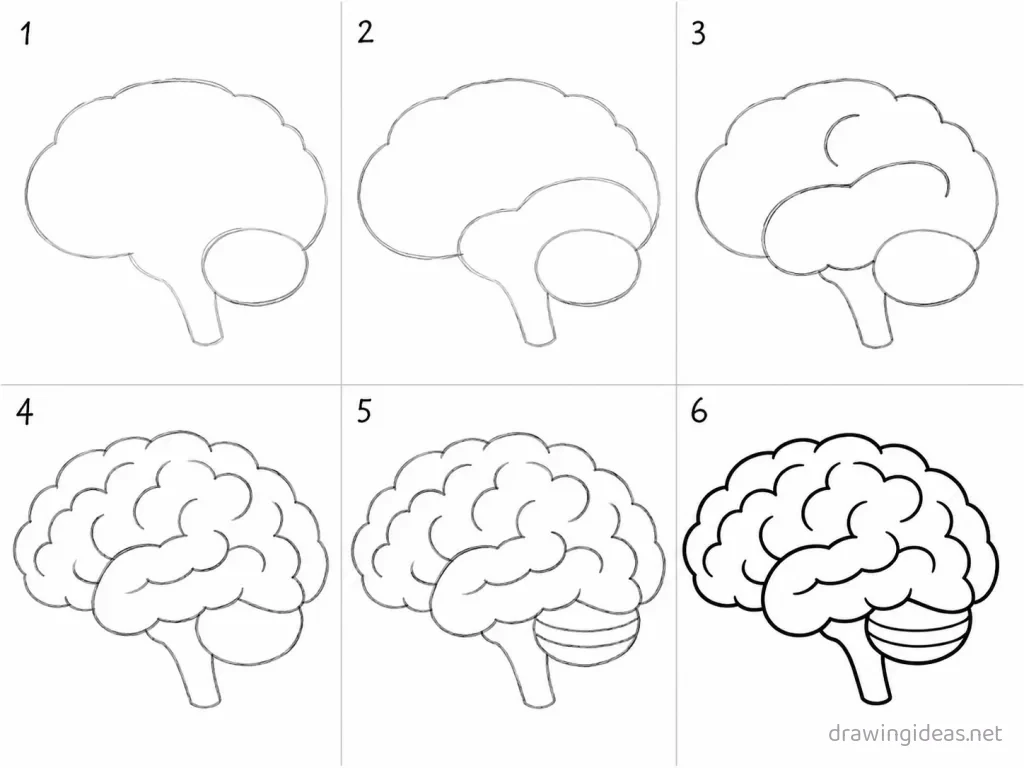
-
Draw the outer shape
A plump oval, slightly flattened on the bottom and fuller at the front — like a boxing glove seen from the side. Keep the lines loose — wobbles are fine at this stage.
-
Mark the two regions
Draw a curving line separating the small cauliflower-shaped cerebellum (lower back) and the stem below it from the big main mass. Simpler is better here: one confident line beats three careful ones.
-
Add the central fold
Sweep one long curve from the front of the brain back toward the cerebellum — the main fold line that everything else branches from. If it looks off, adjust the big shape rather than adding detail.
-
Fill with squiggles
Cover the main mass with connected, worm-like squiggle lines that follow the brain's curve — think of drawing a maze with no straight lines. A rough version of this step is good enough — keep moving.
-
Texture the cerebellum
Give the small back section tighter, parallel wavy lines instead of squiggles — its folds are finer and more regular. Draw this bigger than feels natural; big shapes are easier to control.
-
Shade the grooves
Add shadow inside the deepest squiggle lines and around the bottom edge. Done is better than perfect — finish the step and move on.
Want the full detailed version?
The complete Brain drawing tutorial covers proportions, texture and shading in depth.
Full Brain Drawing Tutorial →Easy Brain Drawing Ideas
Brain as a friendly cartoon
Give it eyes and a smile — the memorable-mnemonic style that makes studying stick.
A step-by-step process strip
Show the brain in stages across three or four panels, with arrows — perfect for processes and cycles.
A poster-style brain with title lettering
Big title, the brain center-stage, two or three fact callouts — the class-project format.
A labeled diagram of the brain
The classic homework version: clean outline, distinct regions, straight pointer lines to printed labels.
Easy Drawing Tips
- Finish it even if it looks wrong at step 3. Every finished easy drawing teaches the whole sequence; abandoned perfect starts teach nothing.
- Use a light pencil for the shape stage and press harder only on the final outline — being able to erase guide lines is what makes the simple method forgiving.
- Draw big. Beginners instinctively draw tiny, and tiny drawings are actually harder — small curves demand more finger control than big arm strokes. Fill at least half the page.
FAQ
What is the easiest way to draw a brain?
Start with a cloud-like oval split by one curving line and keep every line light until the shape looks right — that's the entire method above. Most beginners get a recognizable brain drawing on the first try because each step is one simple move.
Can kids follow this brain drawing tutorial?
Yes — this version was written for young artists: big forgiving shapes, no shading, no fine details. Ages 5-6 and up can usually follow along with a little help reading the steps.
How long does the easy version take?
About five minutes for the basic drawing — roughly half the time of the full tutorial. Adding color takes another few minutes.